Cycle-Driven Engineering: The Organizational Architecture for AI-Assisted Engineering
The Constraint Layer is the organizational architecture of Cycle-Driven Engineering: decision ownership, boundaries, and reusable assets for AI-assisted delivery.
I recently introduced Cycle-Driven Engineering as a framework for adapting software delivery to the realities of AI-assisted engineering. The central idea was that software delivery is not a single process, but a system composed of multiple interconnected, circular layers. Improving only one of those layers inevitably creates pressure on the others.
Today, many organizations are introducing AI almost exclusively at the Execution Layer. They invest in coding agents, automate implementation tasks and significantly increase their development capacity. However, the organizational structures surrounding those teams often remain unchanged. Decisions still follow the same approval chains, knowledge still lives inside silos, and feedback continues to flow through processes that were designed long before AI-assisted engineering became possible.
This creates an interesting imbalance. The ability to execute changes accelerates, while the organization’s ability to absorb, validate and respond to those changes does not. The result is not necessarily faster delivery, but an increasing amount of friction between different parts of the system.
This is why the first layer in Cycle-Driven Engineering is the Constraint Layer.
The Constraint Layer is not concerned with implementation details. Instead, it defines the organizational architecture within which implementation takes place. It establishes decision boundaries, clarifies ownership, makes organizational knowledge explicit and creates the conditions under which teams can operate autonomously without continuously depending on other teams.
The following sections explore what this organizational architecture looks like and why it becomes increasingly important as AI-assisted engineering continues to accelerate software delivery.
Software Delivery Is an Organizational System
Software delivery is often perceived as an engineering process. In reality, engineering is only one component of a much larger organizational system.
Every software product exists within a network of functions that continuously exchange information and make decisions. Product Management identifies opportunities and priorities. Engineering translates those decisions into software. Customer Success closes the loop by bringing customer feedback back into the organization.
Architecture, Security, Legal, Operations and many other specialized functions contribute their own expertise throughout the delivery cycle. None of these functions operate in isolation and none of them determine the outcome independently.
The composition of this system differs from one organization to another. In some companies, software delivery decisions primarily involve Product Management, Engineering and Customer Success. Others may require Operations, Security or Platform Engineering to participate. Organizations operating in regulated industries may also involve Legal, Compliance or Risk Management, while commercial organizations often include Sales or Marketing in the process. The specific functions are less important than understanding which parts of the organization influence decisions that ultimately affect software delivery.
As a result, software delivery is not simply the sum of engineering activities. It is an emergent property of how effectively the organization as a whole processes information, makes decisions and responds to feedback. Improving a single layer of that system inevitably changes the demands placed on the others.
The Organizational Unit Defines the Optimization Target
Every organizational structure is built around a primary organizational unit. That unit becomes the natural focus for planning, ownership, decision-making and performance measurement.
In traditional software organizations, this unit is typically the functional department and, as described in the previous paragraphs, several functions are de facto involved in the delivery process as a whole. The exact composition varies from one organization to another, but the organizational architecture itself is quite repetitive.
This has proven to be an effective way of developing deep expertise. Individual functions can establish standards, share knowledge and continuously improve their own practices. As organizations grow, this specialization also makes them easier to manage.
However, in software delivery, we already established that every meaningful change requires multiple organizational functions to contribute decisions throughout the delivery cycle. Therefore, the delivery system continuously crosses functional boundaries.
This creates an important distinction between the organizational structure and the system it is expected to optimize. The organizational unit is the functional department, while the system being optimized is software delivery itself.
Cycle-Driven Engineering starts from the assumption that these two should be aligned. If software delivery is the system being optimized, then software delivery should also become the primary organizational unit.
Organizing Around Software Delivery
If software delivery becomes the primary organizational unit, the structure of the organization naturally changes.
Instead of organizing people primarily around specialized functions, we should organize around the delivery systems responsible for creating value. Each organizational unit becomes responsible for a complete software delivery cycle rather than an individual function within that cycle.
This does not imply that every organizational unit looks identical. The composition depends on the product, the business domain and the complexity of the decisions being made. A small SaaS company may require Product Management, Engineering and Customer Success to work as a single delivery unit. A larger enterprise may additionally include Design, Operations, Data, Security or other specialized functions. The objective is not to create a predefined team structure, but to ensure that the organizational functions required to make day-to-day delivery decisions are part of the same organizational unit.
Cycle-Driven Engineering refers to these organizational units as Delivery PODs.
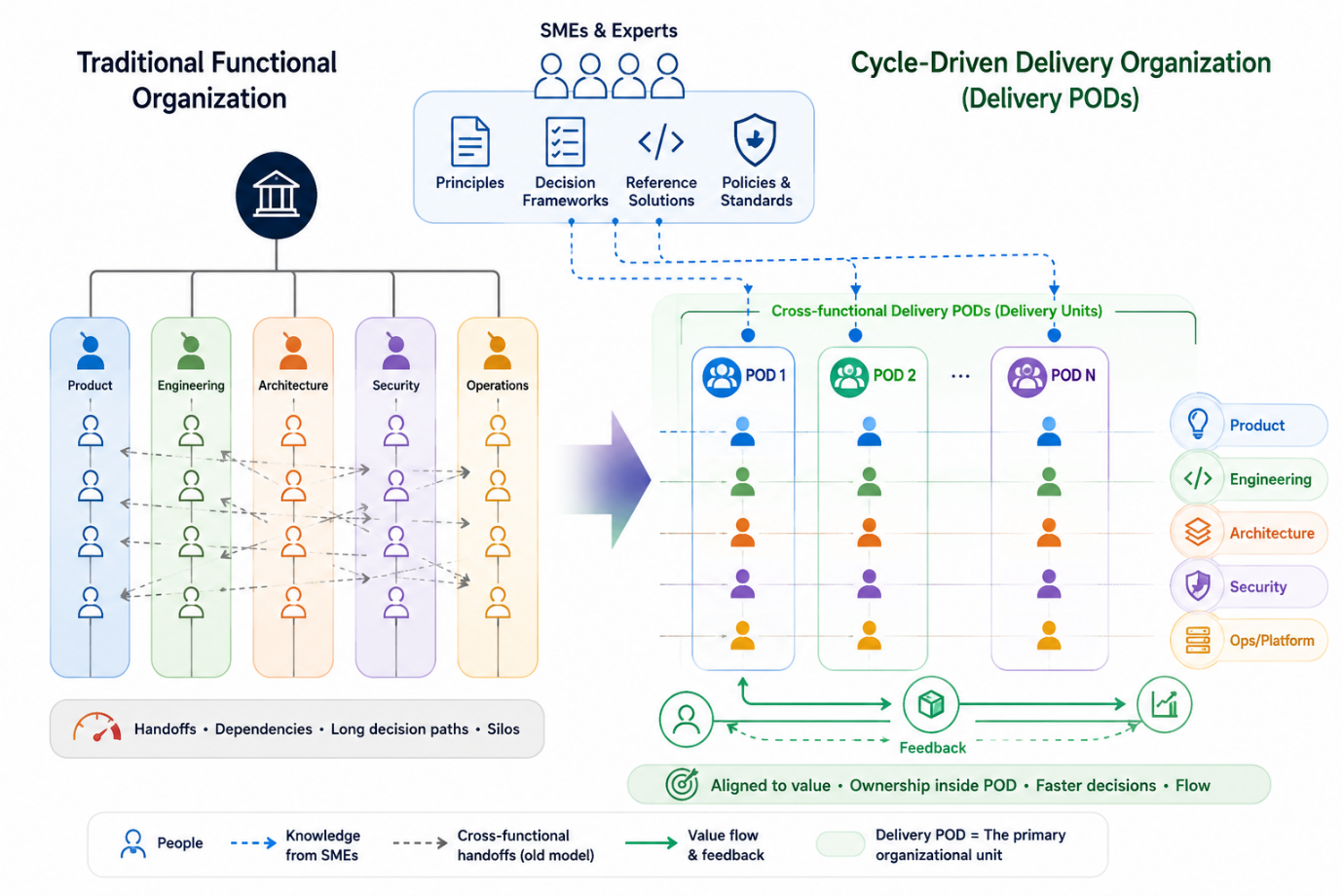
A Delivery POD owns a business outcome rather than a function. It is responsible for continuously receiving feedback, making decisions, implementing changes and observing the results of those changes. The majority of decisions required to complete this cycle should be made within the POD itself, without depending on external organizational functions.
This produces some interesting effects. Communication paths become shorter because the people required to make most delivery decisions are already part of the same organizational unit. Feedback loops become tighter because customer insights, product decisions and implementation no longer need to traverse multiple organizational boundaries before resulting in action.
The transition to Delivery PODs does not eliminate specialization, but it changes where specialization resides within the organization. That distinction becomes the foundation of the next aspect of the Constraint Layer.
Decision Ownership
Creating Delivery PODs does not automatically create autonomous teams. Autonomy is not determined by organizational charts. It is determined by decision ownership.
Every software organization continuously makes thousands of decisions. Some relate to product direction, others to architecture, security, infrastructure, compliance or customer communication. Those decisions are made somewhere within the organization. The way decision ownership is distributed ultimately determines how software is delivered.
Traditional organizations often answer this by assigning decisions to functional departments. Product decisions belong to Product Management. Architectural decisions belong to Architecture. Security decisions belong to Security. As a result, software delivery becomes a continuous exchange of decisions between organizational functions.
A Delivery POD should own every decision that directly contributes to its ability to deliver software continuously, provided that decision remains within clearly defined organizational boundaries. Decisions should only leave the POD when they exceed those boundaries or affect the organization beyond the scope of a single delivery system.
The objective is not to maximize the number of decisions made by the POD, but to maximize the number of decisions that can be made by the POD without introducing unnecessary organizational dependencies.
Autonomy therefore becomes an architectural property of the organization rather than a management philosophy. It emerges from clear decision ownership, explicit boundaries and a shared understanding of where responsibility begins and ends.
Defining Organizational Boundaries
No Delivery POD can operate in complete isolation. Some decisions naturally extend beyond the scope of a single product, service or business capability. Architectural consistency, security policies, regulatory compliance and platform standards are examples where decisions made by one team may directly affect many others.
For this reason, autonomous software delivery does not imply unrestricted decision-making. It requires clear organizational boundaries that distinguish between decisions owned by the Delivery POD and decisions that remain shared across the organization.
These boundaries should be explicit. They should evolve as the organization evolves and they should be understood by every Delivery POD. Unclear boundaries inevitably lead to unnecessary discussions, inconsistent decisions and increasing coordination costs. Boundaries that are too restrictive create the opposite problem by preventing teams from responding quickly to feedback within their own delivery cycle.
The role of the Constraint Layer is therefore not to maximize autonomy or standardization, but to establish the conditions under which both can coexist.
Once these boundaries have been established, the responsibility for defining and maintaining them naturally belongs to the organizational functions with the deepest expertise in their respective domains.
Subject Matter Experts Become System Designers
The introduction of Delivery PODs does not eliminate the need for specialized organizational functions. Product Management, Architecture, Security, Operations, Legal and other functions continue to play a fundamental role in software delivery. What changes is the way their expertise contributes to the delivery process.
In traditional organizations, Subject Matter Experts (SMEs) frequently participate in day-to-day delivery activities. They review designs, approve exceptions, answer implementation questions and help teams navigate decisions that fall outside their immediate expertise. As organizations grow, this often results in an increasing number of interactions between Delivery PODs and specialized functions.
Within the Constraint Layer, the objective is not to remove these interactions entirely. Some decisions naturally have organization-wide implications and should continue to involve the appropriate SMEs. The objective is to continuously reduce unnecessary dependencies by transforming recurring decisions into explicit organizational knowledge.
This gradually changes the role of Subject Matter Experts. Rather than repeatedly participating in the same delivery decisions, they continuously improve the system within which those decisions are made.
Architects refine architectural principles. Security specialists improve security policies. Platform teams evolve the engineering platform. Product specialists establish decision frameworks. Each organizational function focuses on improving the environment that enables Delivery PODs to operate autonomously within clearly defined organizational boundaries.
As Delivery PODs mature, the contribution of Subject Matter Experts increasingly shifts from making individual decisions to building reusable organizational knowledge that can be applied consistently across every delivery cycle.
Organizational Assets Encode the Operating Model
Cycle-Driven Engineering captures the knowledge produced by Subject Matter Experts as reusable organizational assets. These assets may take many forms, including architectural principles, decision records, security policies, reference implementations, coding standards, platform capabilities, product decision frameworks or compliance guidelines. The specific artifacts are less important than the role they play within the organization.
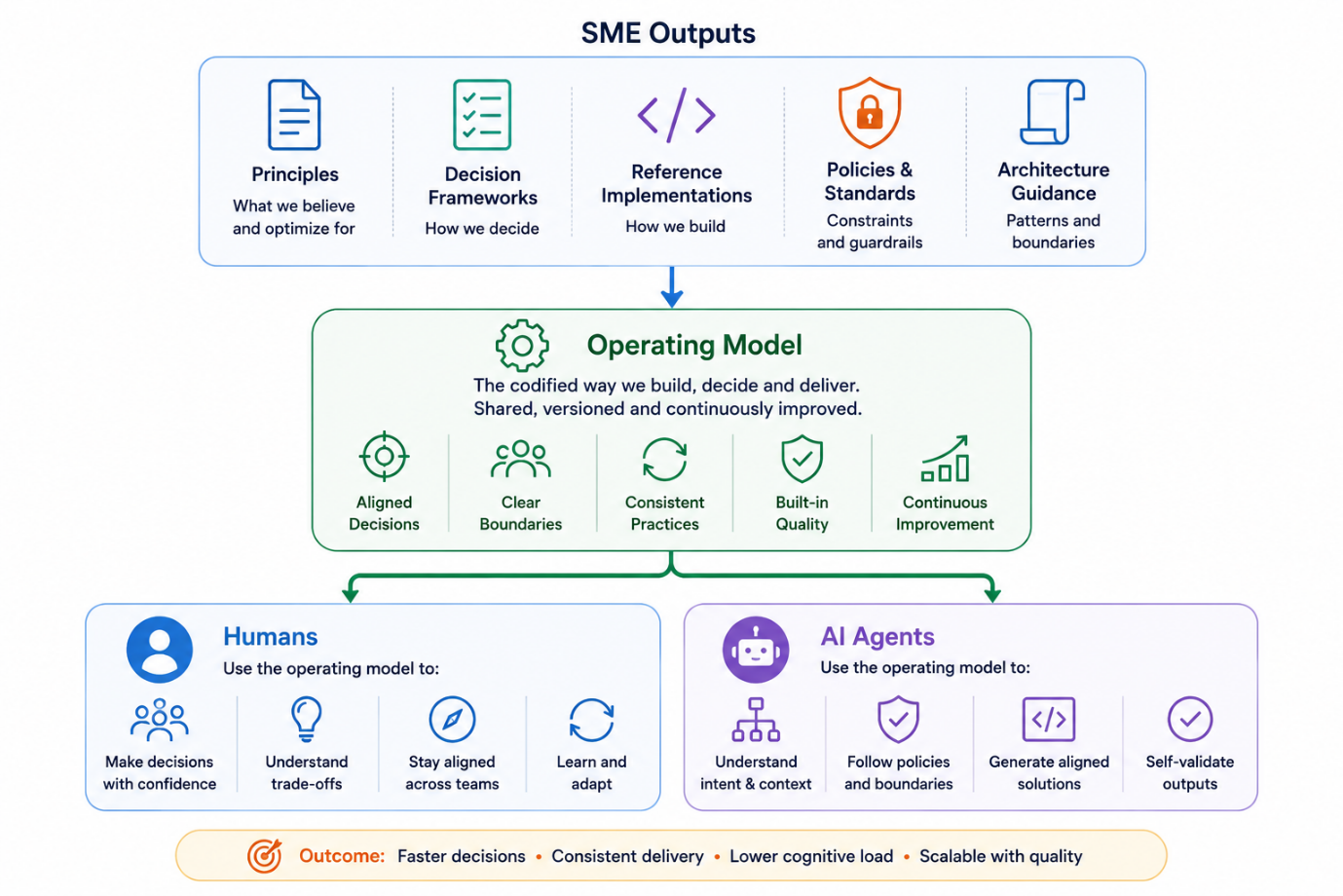
Collectively, these assets describe how software is built within a particular organization. They establish acceptable architectural patterns, define organizational boundaries, document preferred implementation approaches and provide guidance for situations that would otherwise require direct involvement from Subject Matter Experts. Rather than existing as implicit knowledge distributed across experienced individuals, the organization’s way of building software becomes explicit and continuously evolving.
These assets encode the organization’s operating model. They define how software is built, how decisions are made and where organizational boundaries exist. Every Delivery POD applies this operating model continuously throughout the software delivery cycle.
This distinction becomes increasingly important in the context of AI-assisted engineering. Human engineers gradually internalize the operating model through onboarding, collaboration and experience. AI agents have no such mechanism. Every architectural principle, engineering standard or decision framework must be explicitly available before an AI agent starts to perform any meaningful work.
The organizational assets produced within the Constraint Layer therefore serve a dual purpose. They reduce unnecessary dependencies between Delivery PODs and Subject Matter Experts, while simultaneously establishing a common operating model that can be executed consistently by both humans and AI agents.
Decision Latency Becomes an Architectural Concern
Every organizational boundary introduces the possibility of additional decision latency.
Whenever a decision cannot be made within a Delivery POD, it crosses an organizational boundary and depends on another organizational function. In some cases this is both necessary and desirable. Decisions affecting security, regulatory compliance or shared architectural direction often require expertise that extends beyond a single delivery system.
The Constraint Layer does not attempt to eliminate these interactions. Instead, it makes them explicit and treats them as part of the software delivery system.
This has an important implication. The time required to make organizational decisions directly influences the overall feedback cycle. If implementation can happen within minutes but architectural or security decisions require several days, the organization has simply moved the bottleneck from one part of the delivery system to another.
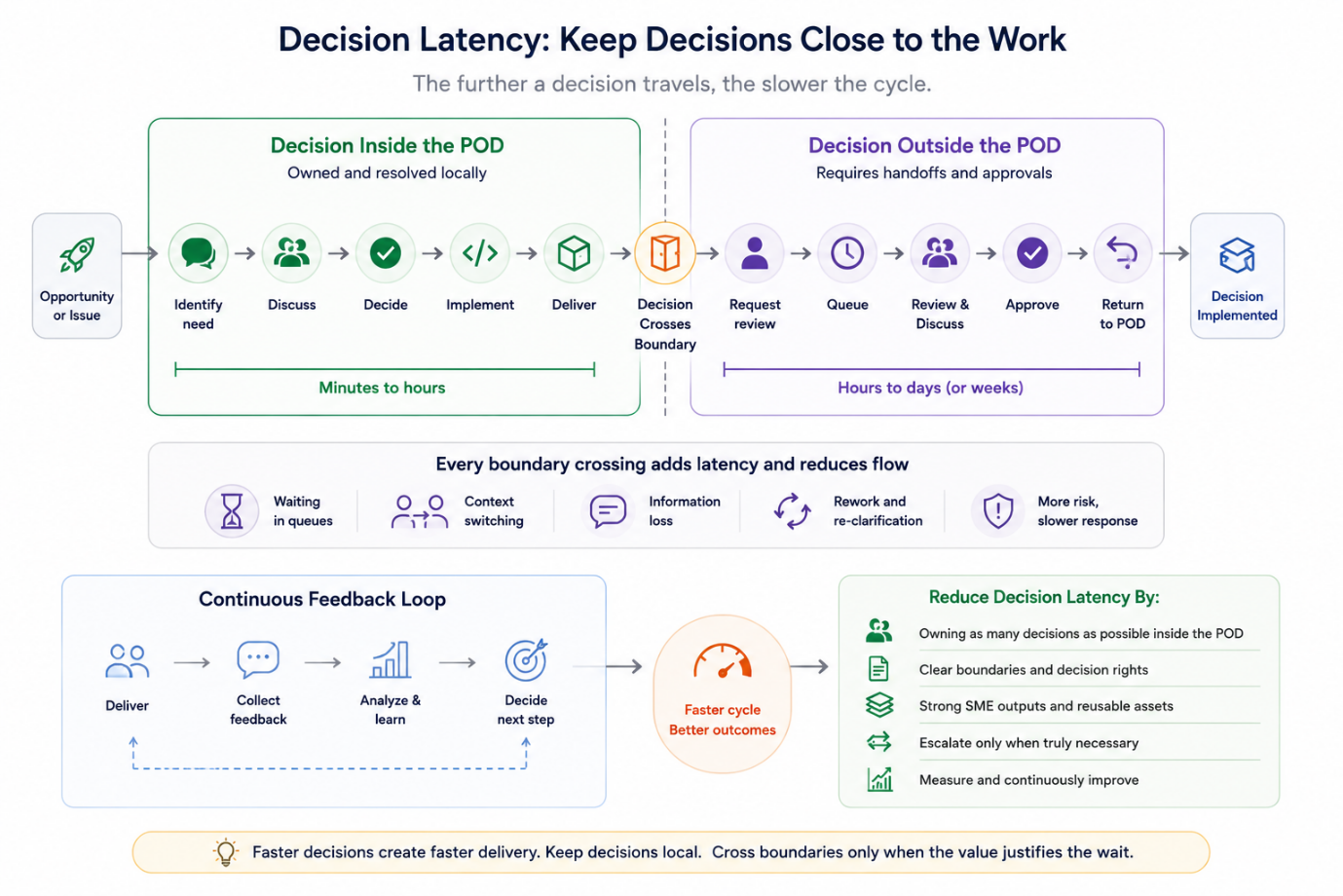
For this reason, decisions that cross organizational boundaries should have clearly defined service levels. Architectural reviews, security approvals, legal assessments and other organization-wide decisions become measurable activities with explicit expectations around responsiveness.
The specific targets will vary between organizations, but the principle remains the same: decision latency should be treated as a design characteristic of the software delivery system rather than an operational inconvenience.
Making decision latency visible also creates opportunities for continuous improvement. Repeated delays may indicate that organizational boundaries need to be adjusted, that additional organizational assets should be created or that certain decisions can be delegated to Delivery PODs.
The objective is not to eliminate organizational oversight, but to continuously reduce the time required for the organization to process decisions while maintaining consistency across the software delivery system.
Making the Constraint Layer Observable
Like every other layer in Cycle-Driven Engineering, the Constraint Layer should be observable.
Organizations often measure delivery outcomes such as deployment frequency, lead time or defect rates. These metrics describe the results produced by the software delivery system, but they provide little insight into how effectively the organizational architecture itself supports those outcomes.
The Constraint Layer introduces a different class of measurements. Rather than focusing exclusively on delivery, it focuses on the organizational mechanisms that enable delivery.
Examples may include:
- the percentage of decisions made entirely within Delivery PODs;
- the average latency of cross-functional decisions;
- the number of recurring SME interventions;
- the number of organizational assets created or updated;
- the proportion of delivery decisions already covered by those assets.
The specific metrics will naturally differ between organizations and should evolve together with the operating model.
Final Thoughts
The Constraint Layer is the organizational foundation of Cycle-Driven Engineering. It defines how software delivery is organized, how decisions are distributed throughout the organization and how expertise is transformed into reusable organizational assets.
Rather than relying on implicit knowledge and continuous coordination between specialized functions, organizations establish explicit operating models that enable Delivery PODs to make decisions autonomously within clearly defined boundaries.
This becomes increasingly important as organizations adopt AI-assisted engineering. AI can significantly accelerate implementation, but implementation remains only one component of the software delivery system. The organizational architecture surrounding that implementation ultimately determines how effectively those capabilities translate into customer value.
The Constraint Layer intentionally separates the definition of organizational knowledge from its application. Subject Matter Experts continuously evolve the organization’s operating model, while Delivery PODs apply that operating model throughout the software delivery cycle. This creates a common foundation that can be followed consistently by both human engineers and AI agents.
The next layer in Cycle-Driven Engineering builds directly on this foundation. Once the organization’s operating model has been externalized into reusable organizational assets, those assets need to be assembled, contextualized and delivered at the point where work is performed. This is the responsibility of the Context Layer.
FAQ
What is the Constraint Layer in Cycle-Driven Engineering?
It is the first layer of the Engineering Loop and the organizational foundation of the model. It does not deal with implementation details. Instead, it defines the organizational architecture around implementation: decision boundaries, ownership, explicit organizational knowledge, and the conditions under which teams can operate autonomously without continuously depending on other teams.
What is a Delivery POD?
A Delivery POD is an organizational unit that owns a business outcome rather than a function. It contains the functions needed to continuously receive feedback, make decisions, implement changes and observe the results, so that most delivery decisions can be made inside the POD without depending on external organizational functions. This shortens communication paths and tightens feedback loops.
How does the Constraint Layer change the role of Subject Matter Experts?
Instead of repeatedly participating in the same delivery decisions, Subject Matter Experts improve the system in which those decisions are made. They turn recurring decisions into reusable organizational assets such as architectural principles, security policies and decision frameworks, which Delivery PODs then apply consistently across every cycle.
Why does the Constraint Layer matter more with AI-assisted engineering?
Human engineers internalize an organization’s operating model through onboarding, collaboration and experience. AI agents have no such mechanism. Every architectural principle, engineering standard and decision framework must be made explicit before an agent can do meaningful work, so the operating model has to be externalized as organizational assets that both humans and agents can follow.